


Cut Through Quarterly 3Q 2026
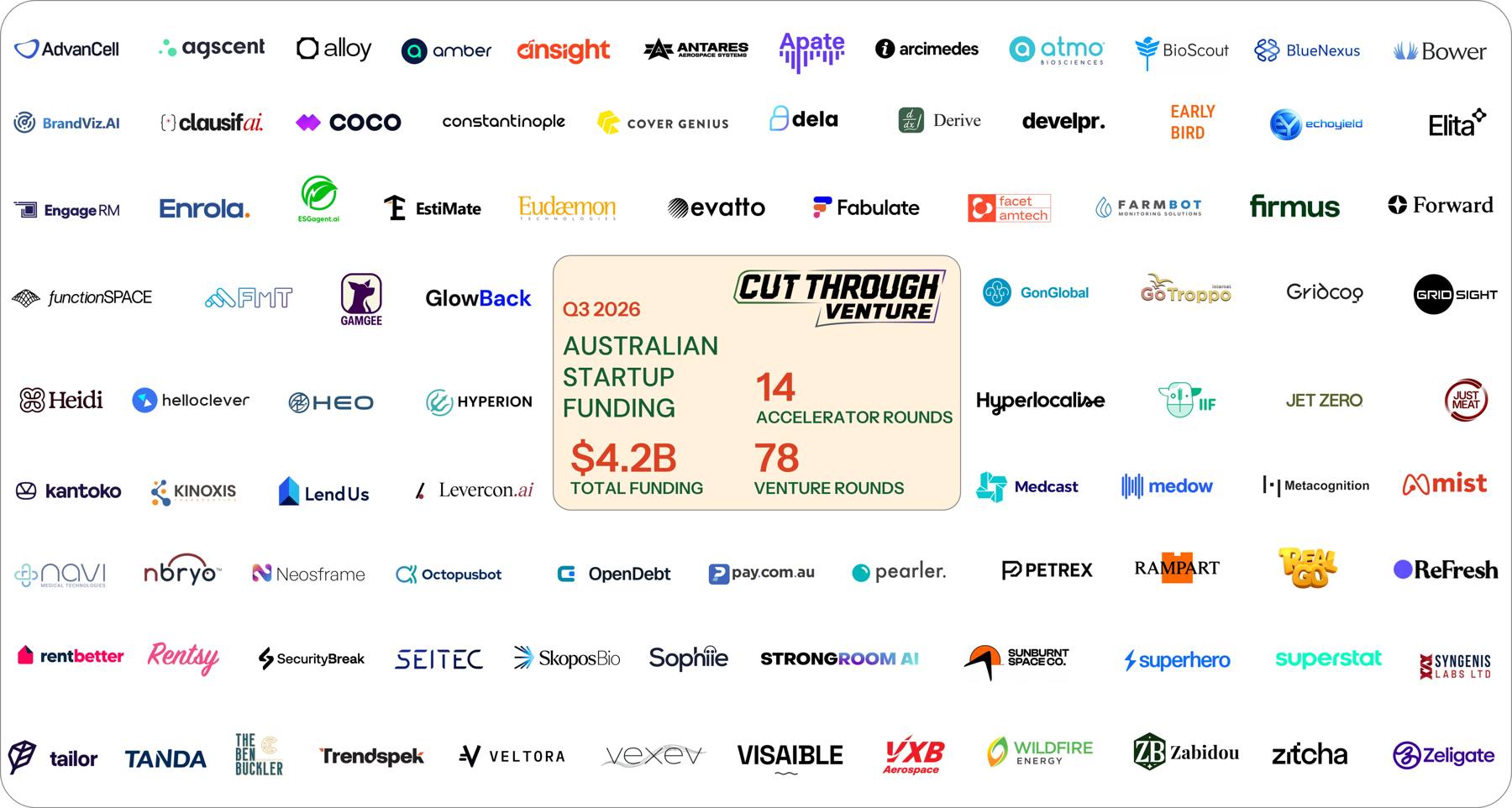
The Cut Through Quarterly Q3 2026 Australian Startup Funding Report examines Australian startup funding activity across the third quarter of 2026, covering capital raised, venture and accelerator round activity, deal sizes, valuations, sector trends, AI adoption, investor sentiment, startup maturity, portfolio health, international investor participation and funding outcomes for female founders.
Q3 2026 delivered $4.2 billion in announced funding across 78 venture deals and 14 accelerator rounds, the largest quarter on record for Australian startup funding and 22% above the previous peak in Q3 2021. The headline was driven almost entirely by one deal: Firmus raised $2.85 billion for AI data centre infrastructure, supplying 69% of the quarter's capital. Excluding Firmus, the quarter still delivered $1.3 billion, flat on Q2 and 80% above Q3 2025. The first nine months of 2026 have now reached $8.0 billion, already ahead of the 2021 full-year total of $6.9 billion.
Key headline numbers
$4.2B in total announced startup funding, the largest quarter on record
78 venture deals
14 accelerator rounds
Firmus' $2.85B round supplied 69% of quarterly capital
Ex-Firmus funding of $1.3B, flat on Q2 and 80% above Q3 2025
Nine-month 2026 funding reached $8.0B, ahead of 2021's full-year $6.9B
Sub-$10M rounds contributed $162M, just 4% of capital
Market interpretation
Q3 2026 was a record quarter by capital but not a broad-based one. The report describes a market where the headline number is a story about data centre infrastructure and a handful of very large rounds, while the rest of the ecosystem continued at roughly the pace set in Q2. Investors remained selective, with capital flowing to companies with AI infrastructure exposure, deep technology, physical assets or proven growth-stage scale.
Five Things to Know from Q3 2026
1. A record quarter built on one deal
Firmus' $2.85B pre-IPO round is the largest Australian venture round on record. Strip out the Firmus deals from this quarter and last and the market raised $1.3B, essentially flat on Q2 and 80% above Q3 2025.
2. Concentration hit an all-time high
The top five deals took 88% of capital, the top 10 took 93% and the top 20 took 96%. Rounds of $50M or more accounted for 90% of all capital raised. Sub-$10M rounds, which make up most of the deal count, contributed just 4%.
3. Physical and deep-tech companies dominated the dollars
Companies with a physical component (infrastructure, hardware, life sciences, climate, space) captured 87% of capital. AdvanCell's $452M Series D was the largest life sciences round in the dataset.
4. AI is now the default
AI-first and AI-enabled companies accounted for 65% of rounds and 85% of capital (around half excluding Firmus). 81% of investors said AI-first startups are priced higher than non-AI peers, with 42% saying significantly higher.
5. Sentiment improved, but LPs are cooling on venture
55% of investors rated the market favourable (up from 47% in Q2) and 42% expect to do more deals this year (up from 30%). However, 65% said their LPs now view venture less favourably than a year ago, and 71% expect no exits from their portfolio in 2026.
Capital surged, breadth did not
The report shows that Q3 lifted 2026 well clear of every prior year on a nine-month basis. At $8.0B through September, 2026 has already passed the 2021 full-year record.
Underneath the headline, the picture is steadier. Ex-Firmus capital was flat on Q2, venture deal count rose modestly from 64 to 78, and accelerator activity picked up with 14 cohort rounds. Sub-$5M rounds recovered to 49 from Q2's low of 31, although that remains below the 2025 quarterly average.
Capital concentration reached a new record
Concentration set another record in Q3:
- The largest deal accounted for 69% of quarterly funding
- The top five deals accounted for 88%
- The top 10 deals accounted for 93%
- The top 20 deals accounted for 96%
- $50M+ rounds accounted for 90% of capital
Sub-$10M rounds, which still represent most of the ecosystem's activity by count, contributed $162M, or 4% of the total.
Largest Deals in Q3 2026
The largest deals show how sharply capital concentrated in infrastructure, life sciences and later-stage fintech and healthtech.
Selected largest rounds
Firmus, $2.85B, AI models and data infrastructure
AdvanCell, $452M Series D, life sciences and biotech
Cover Genius, $143M Series F, fintech
Heidi, $140M Series C, healthtech
Amber, $79M Series E, climate and energy
Constantinople, $62.5M, fintech
pay.com.au, $39M, fintech
HEO, $37M, space and defence
Gridsight, $36.3M, climate and energy
Jet Zero, $30M, climate and energy
Farmbot, $22M, hardware, robotics and sensors
Superhero, $20M, fintech
Pearler, $16M, fintech
Gridcog, $13.5M, climate and energy
SkoposBio, $12M, life sciences and biotech
Atmo, $12M, climate and energy
Alloy, $11.5M, vertical business software
Apate, $11.4M, cybersecurity
Metacognition, $10M, AI models and data infrastructure
What the largest deals reveal
Q3's largest rounds were concentrated in AI infrastructure, life sciences, fintech, healthtech and climate. AdvanCell, Cover Genius and Amber alone accounted for 72% of their sectors' capital in the top 25. The report notes that Firmus withdrew its ASX listing application on 9 October, after the quarter closed, and now intends to pursue private capital instead.
Deal Sizes and Valuations
Median deal sizes by stage
On a 2026 year-to-date basis, median deal sizes remain at or near record highs across every funding stage.
Angel + Pre-Seed: $1.6M
Seed: $3.5M
Series A: $15.5M
Series B+: $38M
Deal count by round size
Activity recovered at the small end of the market after Q2's record low:
Sub-$5M rounds: 49, up from 31 in Q2
$5M–$19.9M rounds: 21, up from 15 in Q2
$20M–$49.9M rounds: 6, down from 7 in Q2
$50M+ rounds: 6, up from 4 in Q2
Investor-reported valuations continued to rise
Weighted average investor-reported valuations increased again in Q3, with the largest movement at Series B and Series C+.
Pre-Seed: $5.4M
Seed: $10M
Series A: $37M
Series B: $88M
Series C+: $225M
AI-First Startups and Valuation Premiums
AI remains the dominant theme in Australian venture.
AI-first companies continue to price above non-AI peers
81% of investors said AI-first startups were priced higher than non-AI peers
42% said they were priced significantly higher
AI accounted for most funding and most deals
By capital raised:
- AI infrastructure: 69%
- AI applications (AI-first and AI-enabled): 16%
- Non-AI: 15%
By deal count:
- AI infrastructure: 2%
- AI applications (AI-first and AI-enabled): 63%
- Non-AI: 35%
AI-first and AI-enabled companies together accounted for 65% of rounds and 85% of capital. Application-layer companies generated most of the AI deal volume, while Firmus' infrastructure round captured most of the capital.
Sector Trends in Q3 2026
Largest sectors by capital raised
AI models and data infrastructure: $2.87B
Life sciences and biotech: $520M
Fintech: $289M
Climate and energy: $164M
Healthtech: $149M
Space and defence: $47M
Hardware, robotics and sensors: $37M
Vertical business software: $28M
Cybersecurity, compliance and digital identity: $14M
Horizontal business software: $13M
Most active sectors by deal count
Life sciences and biotech: 14 deals
Vertical business software: 14 deals
Fintech: 11 deals
Horizontal business software: 11 deals
Climate and energy: 7 deals
Hardware, robotics and sensors: 6 deals
Space and defence: 5 deals
Life sciences and vertical software led deal count, while AI infrastructure and life sciences led capital. Software categories remained active by count but raised little capital, continuing the pattern seen through 2026.
Vertical software remains the preferred software category
Vertical software (2026 YTD): $2.84B across 157 deals
Horizontal software (2026 YTD): $292M across 44 deals
Vertical software represented 91% of software capital in 2026 to date
Investor preference remained firmly tilted toward vertical software:
77% preferred vertical software
23% had no clear preference
0% preferred horizontal software
Net sector excitement was highest for hardware, robotics and sensors (+58%) and vertical software (+48%).
Physical companies took the overwhelming share of capital
Software made up most of the deals reported, but the bulk of capital sat elsewhere. Companies with a physical element took 87% of Q3 capital, and AdvanCell's Series D made life sciences the largest sector after AI infrastructure. Investor excitement followed suit, with hardware, robotics and sensors overtaking vertical software at the top of the survey. Among software pure plays, vertical took 94% of software capital in Q3.
Investor Sentiment in Q3 2026
Sentiment improved on the ground
55% of investors rated the market favourable, up from 47% in Q2
42% expect to do more deals than last year, up from 30% in Q2
LP sentiment moved the other way
65% of investors said LPs view venture less favourably than a year ago
Founders are looking to the US earlier
63% of investors said portfolio companies are moving to or expanding in the US earlier than they used to
72% said Australian headcount at those companies is steady or growing
Startup Maturity
Median company age at funding stage:
Pre-Seed: 1.2 years
Seed: 2.2 years
Series A: 7.1 years
Series B: 9.1 years
Companies are raising their first rounds younger than in any year since 2021, but the climb to Series B is taking far longer. The report attributes part of this to the hangover from 2023 and 2024, when many companies extended runway and delayed raises.
International Investor Participation
33% of 2026 year-to-date rounds included an international investor, up from 27% in 2025
At Pre-Seed and Seed, international participation rose from 25% to 37%
Offshore investors are arriving earlier in the lifecycle. The survey also found that when founders establish a US base, three times as many investors report fewer local staff in global decision-making roles as report more, even though total Australian headcount usually holds.
Female Founder Funding Outcomes
More teams with female founders secured a round in Q3, without a corresponding share of the quarter's capital. Female-only and mixed-gender teams accounted for 32% of deals but only 2.7% of capital, or $114M. The largest deal makes the contrast more extreme, but the report notes that removing it does not close the gap: deal participation is improving faster than access to large cheques. The largest female-founder raise was Constantinople's $62.5M Series B, and the improvement in deal count was concentrated in software and fintech rather than spread across the market.
Portfolio Health and Exits
74% rated portfolio health as good or excellent
Bridge-round recommendations rose to 32%, up from 19% in Q2
52% reported more exit conversations than a year ago
71% expect no exits from their portfolio in 2026
Portfolio health remains solid, but the jump in bridge-round advice and the absence of expected exits point to a liquidity problem that larger funding rounds have not solved.
Employee equity at seed stage
Data from Cake shows the median individual employee equity grant at seed stage fell to 0.14%, a 58% decline, without a matching fall in company valuations. The report flags this as worth watching as founders compete for talent.
Methodology:
The report's funding data is provided by Cut Through Venture and is gathered from public and private ecosystem sources, including:
ASIC filings
Press releases
Social media
Investor memos
Direct submissions from investors and founders
To be included, a funding event must involve an infusion of capital into a startup in exchange for equity. Exits, grants, prizes and secondary equity transactions are excluded.
The investor sentiment survey was completed by 125 participants, including venture capital firms, angel syndicate leads and family offices.
The Q3 2026 report was produced with the support of Corrs Chambers Westgarth, HSBC Innovation Banking, EY, OpenAI and Cake.
Conclusion
The Cut Through Quarterly Q3 2026 Australian Startup Funding Report records the largest quarter in Australian startup funding history at $4.2B, and the first nine months of 2026 have already passed the 2021 full-year record. Yet the quarter's defining feature is concentration: one data centre infrastructure round supplied more than two-thirds of the capital, the top 20 deals took 96%, and sub-$10M rounds contributed just 4%.
The quarter's themes were clear: Firmus carried the market, physical and deep-tech companies dominated the dollars, AI became the default rather than the differentiator, vertical software remained the preferred software category, and on-the-ground sentiment improved even as LPs cooled and exits stayed elusive. Female-founder deal share held at roughly a third, but capital share collapsed to under 3% in a quarter dominated by a few very large rounds.
Download the full Cut Through Quarterly Q3 2026 report to explore the complete funding dataset, largest deals, sector analysis, AI penetration, investor sentiment, portfolio health, international participation and female-founder funding trends.
Previous quarters and annual reports
- Cut Through Quarterly Q2 2026, $1.7B across 64 rounds
- Cut Through Quarterly Q1 2026, $1.8B across 81 rounds
- Cut Through Quarterly Q3 2025, $1.0B across 116 rounds
- Cut Through Quarterly Q2 2025, $812M across 76 rounds
- Cut Through Quarterly Q1 2025, $993M across 100 deals
- State of Australian Startup Funding 2025, $5.4B across 390 deals
Browse every report on the Insights page.