

.png)
Cut Through Quarterly 2Q 2026
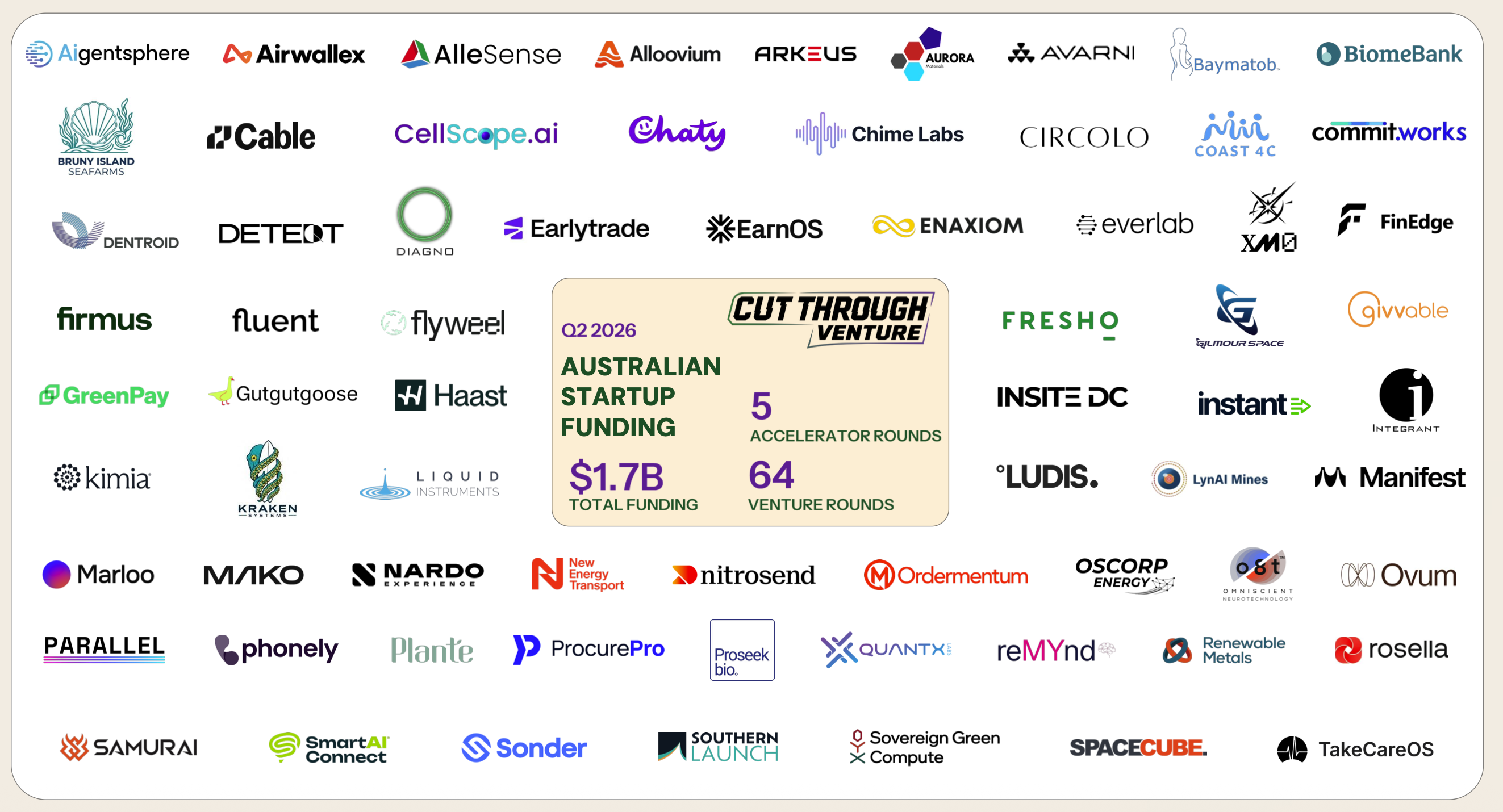
The Cut Through Quarterly Q2 2026 Australian Startup Funding Report examines Australian startup funding activity across the second quarter of 2026, covering capital raised, venture and accelerator round activity, deal sizes, sector trends, AI adoption, investor sentiment, startup maturity, portfolio health, and funding outcomes for female founders.
Q2 2026 delivered $1.7 billion in announced funding across 64 venture rounds and five accelerator rounds, taking first-half funding to roughly $3.5 billion. That makes the first half of 2026 the second-strongest start to a year recorded by Cut Through Venture, behind only 2022. However, the report shows a clear divergence between headline capital and underlying market breadth: capital remained high, while deal count fell to its slowest level since pre-2020.
Key headline numbers
$1.7B in total announced startup funding
64 venture rounds
5 accelerator rounds
First-half 2026 funding reached approximately $3.5B
Q2 funding finished less than $100M below Q1
Venture deal count fell 21% from Q1
Sub-$5M rounds fell to the lowest level in Cut Through Venture’s dataset
Market interpretation
Q2 2026 was not a broad-based funding rebound. The report describes a market where funds are still flowing, but to far fewer companies. The funding environment appears more selective, with investors backing companies that can justify larger rounds through scale, defensibility, AI infrastructure exposure, sector depth, or capital-intensive growth requirements.2
Five Things to Know from Q1 2026
1. Capital remained high, but deal activity narrowed
Q2 delivered one of the strongest quarterly capital totals since the market reset, but deal-making slowed materially. The quarter’s headline total was supported by large rounds rather than broad participation across the ecosystem.
2. Two rounds carried the quarter
Two large deals shaped the entire quarter:
Firmus: $725M strategic round in AI models and data infrastructure
Airwallex: $460M Series H in fintech
Together, these two rounds accounted for close to 70% of all capital raised in Q2. The third-largest deal was $70M, showing the steep drop-off below the top two rounds.
3. Deal sizes reached record annual highs
Median deal sizes are now at record highs across every stage on a full-year view.
- Angel + Pre-Seed: $1.3M
- Seed: $4.0M
- Series A: $18.6M
- Series B+: $41M
The report describes a barbell pattern: investors are paying up at the entry point and again for companies that reach growth stage, while the squeeze is felt in between.
4. AI became even more central to funding outcomes
AI-first, AI-enabled, and AI infrastructure companies represented approximately:
- Three-quarters of Q2 capital
- Two-thirds of Q2 deals
AI penetration deepened fastest at:
- Seed: AI featured in 81% of deals
- Series A: AI featured in 63% of deals
The report also notes a shift within AI itself, with capital rotating away from AI-enabled companies and toward AI-first and infrastructure businesses.
5. Portfolio health improved, but liquidity remains the key question
The quieter positive signal in Q2 came from portfolio health.
- 78% of investors rated portfolio health as good or excellent
- Layoffs and shutdowns declined
- Bridge-round recommendations fell from 31% to 19%
- More than half of investors reported an increase in exit conversations compared with a year ago
Whether those exit conversations convert into completed liquidity events is likely to shape sentiment in the second half of 2026.
Capital surges as the field narrows
The report shows that Q2 continued the strong funding momentum established in Q1. By mid-year, 2026 was tracking well ahead of recent post-boom years and below only the 2022 peak.
However, the underlying deal count tells a different story. Q2 was the slowest quarter for deal count since before 2020, meaning fewer startups captured the majority of capital.
Capital concentration reached a new high
Capital concentration set a fresh record in Q2:
- The largest deal accounted for 42% of quarterly funding
- The top five deals accounted for 80%
- The top 10 deals accounted for 87%
- The top 20 deals accounted for 95%
This means sub-$10M rounds, which still represent much of the ecosystem’s activity by count, contributed only a small share of total capital.
Largest Deals in Q2 2026
The largest deals show how sharply capital concentrated at the top of the market.
Selected largest rounds
Firmus — $725M strategic round, AI models and data infrastructure
Airwallex — $460M Series H, fintech
Liquid Instruments — $70M Series C, hardware, robotics and sensors
Everlab — $65M Series A, healthtech
Osti — $41M Series D, healthtech
DeteQt — $32M Series A, hardware, robotics and sensors
Mako — $28M Series A, climate and energy
Southern Launch — $25M Series A, space and defence
Ark:us — $25M Series A, space and defence
Phonely — $22M Series A, horizontal business software
What the largest deals reveal
Q2’s largest rounds were concentrated in AI infrastructure, fintech, healthtech, hardware, and space. This highlights a funding environment where large cheques are being directed toward companies with infrastructure exposure, technical defensibility, regulated-market opportunities, or globally scalable platforms.
Deal Sizes and Valuations
Median deal sizes by stage
On a full-year basis, median deal sizes are at record highs across every funding stage.
Angel + Pre-Seed: $1.3M
Seed: $4.0M
Series A: $18.6M
Series B+: $41M
Deal-making thinned across every cheque size
The decline in activity was visible across all round-size bands:
Sub-$5M rounds: 31, down from a 2025 quarterly average of 56
$5M–$19.9M rounds: 15, down from a 2025 quarterly average of 19
$20M–$49.9M rounds: 7, down from a 2025 quarterly average of 11
$50M+ rounds: 4, in line with the 2025 quarterly average
The sharpest decline came in sub-$5M rounds, pointing to a tougher environment for smaller early-stage raisers.
Investor-reported valuations edged higher
Investor-reported valuations increased across stages in Q2, with the clearest movement at Series A and Series C+.
Weighted average investor-reported valuations were:
Pre-Seed: $5.3M
Seed: $10M
Series A: $35M
Series B: $79M
Series C+: $158M
The report notes that the uplift appears selective rather than broad, with around half of investors still reporting no meaningful change in valuations.
AI-First Startups and Valuation Premiums
AI remains one of the most important themes in Q2 2026.
AI-first companies continue to price above non-AI peers
Investor survey responses show a continuing valuation premium for AI-first startups:
46% of investors said AI-first startups were priced somewhat higher than non-AI peers
39% said they were priced significantly higher
13% said there was no difference
Only 4% said AI-first startups were priced somewhat lower
AI moved deeper into the funding market
AI-related companies accounted for most Q2 funding and deal activity.
By capital raised:
- AI-first: 51%
- AI-enabled: 14%
- Non-AI: 35%
By deal count:
- AI-first: 32%
- AI-enabled: 39%
- Non-AI: 29%
The report shows that application-layer companies generated much of the AI deal volume, while Firmus’ AI infrastructure round captured most of the capital.
Sector Trends in Q2 2026
Capital and activity moved in different directions
Q2 showed a sharp gap between the sectors receiving the most capital and those recording the most deals.
Largest sectors by capital raised
AI models and data infrastructure: $730M
Fintech: $483M
Hardware, robotics and sensors: $117M
Healthtech: $111M
Vertical business software: $71M
Space and defence: $64M
Climate and energy: $53M
Life sciences and biotech: $31M
Horizontal business software: $26M
Cybersecurity, compliance and digital identity: $18M
Marketplace: $9M
Most active sectors by deal count
Vertical business software: 15 deals
Climate and energy: 11 deals
Hardware, robotics and sensors: 8 deals
Life sciences and biotech: 8 deals
Fintech: 6 deals
Healthtech: 6 deals
Vertical software and climate led in deal count, while fintech and AI infrastructure led capital raised. The difference shows why sector ranking depends heavily on whether the focus is dollars or deal volume.
Vertical software is seen as more defensible
The report shows vertical software continuing to dominate software investment in Q2.
Vertical software: $822M across 39 deals
Horizontal software: $48M across 10 deals
Vertical software represented 94% of software capital
Vertical software represented 80% of software deals
Investor preference also remained strongly tilted toward vertical software:
72% preferred vertical software
28% had no clear preference
0% preferred horizontal software
Why the vertical/horizontal split matters
The report frames vertical software as a relative “AI safe haven” because of workflow depth, domain-specific data, customer lock-in, and industry-specific distribution. Horizontal software is seen as more exposed to AI-driven replication and commoditisation.
Physical exposure increased, but AI infrastructure drove the dollars
Businesses with a physical component took a larger share of capital and deals in Q2 than in Q1. However, the biggest increase came from AI models and data infrastructure rather than traditional hardware alone.
Selected physical and frontier categories included:
AI models and data infrastructure: $726M
Hardware, robotics and sensors: $117M
Healthtech: $65M
Space and defence: $64M
Climate and energy: $53M
Life sciences and biotech: $31M
Sector dynamics are shaping round sizes
The report finds that sector now influences cheque size at least as much as stage. Capital-intensive sectors such as space and defence, hardware and robotics, and AI infrastructure attracted larger cheques, while software categories generally raised less despite stronger deal counts.
Median deal sizes by selected sector:
Space and defence: $25M
Cybersecurity: $9M
Marketplace: $8.5M
Hardware and robotics: $6M
Climate and energy: $5M
Vertical software: $4M
Healthtech: $4M
AI models and data infrastructure: $4M
Life sciences: $2M
Horizontal software: $1.6M
Investor Sentiment in Q2 2026
Sentiment steadied, but conviction cooled
Investor sentiment was stable but less enthusiastic than in earlier periods. The report describes the near-term view as more cautious than optimistic.
Market sentiment
47% of investors rated the market moderately favourable
3% rated it highly favourable
42% were neutral
8% rated conditions unfavourable
Expected deal volume for 2026
30% expect to do more deals than last year
45% expect about the same number of deals
25% expect fewer deals than last year
Investor priorities
The top priorities for the quarter were:
Investing in new startups
Ensuring current portfolios remain well capitalised
Fundraising from LPs
Internal initiatives
Marketing and business development
This points to investors remaining active but more selective in deployment.
Startup Maturity and the Longer Path to Growth Capital
Founders are raising earlier
The report shows that companies are raising their first cheques earlier than at any point shown in the dataset.
Median company age at funding stage:
Pre-Seed: 1.0 years
Seed: 2.8 years
Series A: 5.9 years
Series B: 11.0 years
Series B is taking longer to reach
The median age of companies raising Series B has more than doubled from the 2021 market peak. The report notes that the median journey from Pre-Seed to Series B has widened to about 10 years, indicating a tougher climb to growth capital.
Female Founder Funding Outcomes
Female-founder capital rose sharply, but concentration drove the result
Female-only and mixed-gender teams raised a much larger amount of capital in Q2, lifting their share of total funding to around one-third. However, the increase was driven by a small number of large rounds rather than broad-based participation.
The two largest female-founder rounds were:
- Airwallex: $460M Series H
- Liquid Instruments: $70M Series C
Together, these two late-stage rounds made up almost the entire funding figure for female-founder and mixed-gender teams.
Female-founder activity by sector
Female-only and mixed-gender teams closed fewer deals in Q2, with activity shifting toward frontier and technical sectors.
Most active sectors by deal count:
Life sciences and biotech: 4 deals
Climate and energy: 3 deals
AI models and data infrastructure: 2 deals
Fintech: 2 deals
Hardware, robotics and sensors: 2 deals
Healthtech: 2 deals
Largest female-founder funding categories
Fintech: $460M across 2 deals
Hardware, robotics and sensors: $72M across 2 deals
Life sciences and biotech: $8M across 4 deals
AI models and data infrastructure: $5M across 2 deals
Healthtech: $4M across 2 deals
Representation shifted up the stages
Female and mixed-gender participation declined at Angel and Pre-Seed but increased at Seed, Series A, and Series B+. The report cautions that stage-level figures should be interpreted carefully because individual large transactions can heavily distort the data.
Portfolio health improved
Most investors reported healthier portfolios in Q2.
74% rated portfolio health as good
4% rated portfolio health as excellent
21% rated portfolio health as fair
Fundraising advice shifted
Investor recommendations to portfolio companies changed from Q2 2025 to Q2 2026:
Delay fundraising: increased to 11%
Raise a bridge round: fell to 19%
Raise a normal round: increased to 70%
This suggests stronger companies may once again be able to raise normal rounds, while weaker companies are still being advised to wait.
Exit conversations increased
Investor-reported exit activity is rising:
51% reported more exit conversations than last year
40% reported the same level
9% reported fewer exit conversations
The report suggests that completed exits, more than any single funding round, may be the key driver of market sentiment in the second half of 2026.
Methodology:
The report’s funding data is provided by Cut Through Venture and is gathered from public and private ecosystem sources, including:
ASIC filings
Press releases
Social media
Investor memos
Direct submissions from investors and founders
To be included, a funding event must involve an infusion of capital into a startup in exchange for equity. Exits, grants, prizes, and secondary equity transactions are excluded.
The investor sentiment survey was completed by 135 participants, including venture capital firms, angel syndicate leads, and family offices.
Conclusion
The Cut Through Quarterly Q2 2026 Australian Startup Funding Report shows a market that is strong in headline capital but thin in participation. The first half of 2026 reached nearly $3.5B, making it the second-strongest start to a year recorded by Cut Through Venture. Yet Q2 also recorded a sharp slowdown in deal count, record capital concentration, and the lowest sub-$5M round count in the dataset.
The quarter’s defining themes were clear: two mega-rounds carried the market, AI moved deeper into funding decisions, vertical software remained the preferred software category, deal sizes reached record annual highs, and portfolio health improved even as investors stayed selective. Female-founder capital also rose sharply, although the increase was driven mainly by two large late-stage rounds rather than broad participation.
Download the full Cut Through Quarterly Q2 2026 report to explore the complete funding dataset, largest deals, sector analysis, AI penetration, investor sentiment, portfolio health, and female-founder funding trends.
Previous quarters and annual reports
- Cut Through Quarterly Q1 2026, $1.8B across 81 rounds
- Cut Through Quarterly Q3 2025, $1.0B across 116 rounds
- Cut Through Quarterly Q2 2025, $812M across 76 rounds
- Cut Through Quarterly Q1 2025, $993M across 100 deals
- State of Australian Startup Funding 2025, $5.4B across 390 deals
Browse every report on the Insights page.